
A New Dance and an Old One

Choreography: Sean Curran, Benjamin Freedman
Music: Leoš Janáček; Johannes Brahms
Performers: Maurice Dowell, Liviya England, Gabriella Flanders, Mackenzie Ginter, Jacoby Pruitt, Kacie Boblitt, Tracy Dunbar, Flora Ferguson, Jordan Powell, Matthew Spangler, Miles Yeung
Costume Design: Zane Pihlstrom
Lighting Design: Susan Hamburger
Aug 29, 2026
Jack Crystal Theater
New York University, Tisch School of the Arts

Dance is a living legacy, a lineage passed down from body to body. So too is choreographic mentorship, with younger choreographers absorbing wisdom and skill through the embodied practice of working with seasoned dance makers. In A New Dance and an Old One, Sean Curran and longtime collaborator Benjamin Freedman present a shared evening of work that celebrates both the past and the present and illustrates the power of sharing time.
Curran and Freedman met in 2011, when Freedman was a student at NYU Tisch School of the Arts. After graduating, Freedman went on to dance with Curran’s company and has been working with him ever since. Most pleasing about this collaborative evening is the evident connectivity between the two artists’ choreographic styles without diminishing either’s distinct voice. Elements of craft- the use of space, connection to the music in surprising ways, patterning of bodies, and use of counterpoint- form a visible throughline. However, Freedman uses those elements in ways distinct from Curran. As a student of the craft, a dance educator, and an active choreographer myself, seeing this living embodiment of transferred knowledge is a beautiful thing.

First on the program is the old dance. Curran’s The Nothing That Is Not There And The Nothing That Is, choreographed in 1998, is a meditation on love and loss. Both accessibly pedestrian and intricately technical, The Nothing That Is… serves as a masterclass in choreographic form without being at all academic. Curran’s hallmark use of quirky timing and specificity of gesture lends his work an alluring quality. As recognizable forms appear and repeat with variations in texture, complexity builds organically. Using stillness as counterpoint, with dancers quietly observing one another in duets, trios, or solos, Curran draws the audience’s eye to the relationships between them. Sometimes tender and warm, at others combative and harsh, observation becomes an allowing, making space for connection, parting, grief, and belonging. Curran’s use of groupings and space - simultaneous duets on a diagonal, solos that happen in the downstage corner, trios that arise out of group activity - builds a world, while familiar yet divergent gestures allow us to fully inhabit it.

The Nothing That Is… could easily be an instructional tool in composition; however, it is much more than that. As dancers meet and part, walk toward, around, and through one another, their meetings and partings become significant. They sometimes adopt each other’s movements, creating something new from something familiar, holding the essence of a dancer in their bodies after that dancer has left the group, like carrying the memory of a loved one through time and space. Eye contact sometimes becomes more powerful than touch as they pass, and the movement vocabulary, linear with surprising moments of curvature and release, grounds and connects them. The Nothing That Is… has no extraneous movement for movement’s sake; every phrase and relationship serves the overarching purpose. In the end, one dancer walks downstage alone, mirroring the opening, and when the lights go dark on this world, we are left with solemnity, grace, and an appreciation for the beauty of human connection.

While both pieces on the program highlight human relationships, Freedman’s newest work, An Orange, Peeled, which explores the currents of sensuality, courtship, and desire, is the antidote to Curran’s reflection on loss. There is humor, too. Characters like the femme fatale, the eager man, the competitive egomaniac, and the aloof seductress, all clothed in 1950s-style swimwear, play against Johannes Brahms’ dramatic, operatic score. A familiar mating ritual begins. Moments of tenderness, contest, and fickle connection become metaphors for youthful attraction and the foibles of finding love.
Freedman, like Curran, has a penchant for beautiful and interesting gestures, though his gestures emerge within a more liquid yet still highly athletic framework. We also see echoes of some of Curran’s familiar spatial structures- dancers spinning out from a large group into a cacophony of movement that resolves into quiet moments or sudden solos, or simultaneous duets that happen close together but not in parallel. One can clearly see Curran’s influence on Freedman’s craft, particularly in the cleanliness of form, but Freedman creates a movement vocabulary all his own. Sinuousness outweighs angularity, and he emphasizes differences in weight and flow.

Both choreographers are adept at playing with their music- sometimes landing on the nose of their powerful scores, at others countering large orchestral swells with stillness or smaller movements, further adding texture to the overall composition. There is a particularly exciting moment in An Orange, Peeled when the dancers’ speed and abandon mimic the velocity of the trills within the music in an escalating frenzy.
Evolving from subtly humorous stereotypes, An Orange, Peeled becomes a meaningful reflection on desire and the search for connection. The paradox of choice leaves dancers and audience alike feeling isolated and lonely, as deeper connection remains elusive and dancers leave one passionate duet only to begin another. Dancer Miles Yeung performs a physically demanding, angst-filled solo while the other dancers lounge before him in mocking postures. Freedman’s choreography is sensual yet athletic, the dancers’ physical touch in complex partnering moments portraying lust, warmth, frustration, and sometimes ambivalence.
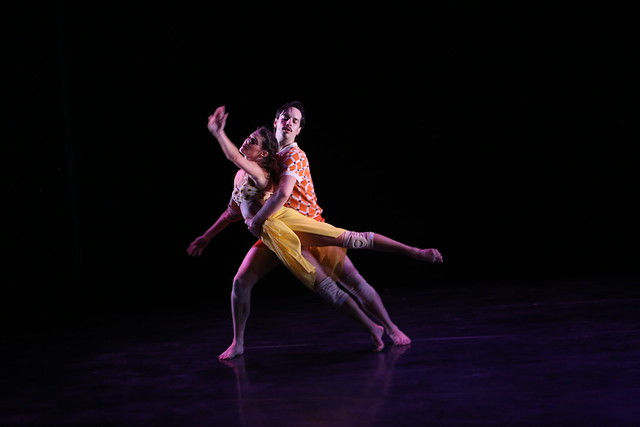
Ultimately, A New Dance and an Old One is as much about the lineage of dance as it is about the works themselves. There is something deeply generous in Curran sharing the stage with a choreographer he has mentored and whose work he clearly admires, not simply passing down knowledge but making space for that knowledge to evolve into something new. Freedman carries traces of Curran’s influence in his attention to form, musicality, gesture, and spatial relationships, but what emerges is palpably his own.
Dance is passed from body to body, but it does not remain unchanged in the passing. Perhaps that is what makes an evening like this particularly meaningful: we are able to see lineage not as imitation, but as continuation. Curran and Freedman remind us that mentorship at its best does not reproduce an artist. It gives another artist something to carry forward.


Comments