
SarAika Movement Collective- Just Keep Waiting

Choreography: Sara Pizzi, Aika Takeshima, Katia Tubini
Dancers: Aly Candland, Avery Boose, Casey Layden, Aviana Goodman-Fish, Rylan Joenk, Kaede Hibara
November 19, 2025
Speyer Hall, University Settlement

Five women lay sprawled on chairs and beneath a table. A sixth woman enters with an old-school landline phone, sits, and places a call. A familiar recorded voice parrots a well-worn speech: “Your call is important to us. This call may be monitored or recorded for quality assurance.” The audience chuckles softly; we all know where this is going. Each time the disembodied voice delivers a prompt, the prone dancers perk up, only to wither again in frustration. “All representatives are engaged with another caller.” Humor and irritation mount as the caller is prompted to press buttons for service, only to be misunderstood and rerouted—the other dancers popping up and lying back down like mechanical moles in a 1970s arcade game. When they are finally told to “just keep waiting,” their acquiescence takes on a more somber tone.
Created through a year-long collaboration with choreographer Katia Tubini of LPP Dance Project in Verona, Italy, Just Keep Waiting embodies—in both process and product—the very qualities it seeks to illuminate: anticipation, persistence, and the tension inherent in the ubiquitous act of waiting. Through highly athletic and evocative choreography, the cast of six female performers takes the audience on a journey through boredom, anxiety, irritation, and, finally, acceptance.

Dancers casually munch on a bag of chips, flip idly through a magazine, and bang impatiently on a bathroom door. Movements evolve from leisurely and sustained to sharp and erratic, often within the same phrase, highlighting the performers' struggle for emotional regulation. The piece builds slowly, and the use of a table, chairs, and props lends the work a theatrical feel. However, these items are not merely set pieces; throughout the evening, the performers push, pull, and crawl on, under, and over them. Even more fascinating is their use of doorways and walls as weight-bearing partners.

Choreographers Aika Takeshima, Sara Pizzi, and Tubini make full use of Speyer Hall at University Settlement. A three-quarter-length white wall upstage reveals an exposed backstage doorway leading to a bathroom. During one particularly ominous section, two dancers perform a duet full of inventive lifts and supports, using the door frame and walls to aid them in mesmerizing contortions. At one point, a dancer disappears for a moment—likely standing on a counter just outside our sightlines—then falls back suddenly into the arms of her partner. Offsetting this kaleidoscopic duet, two other dancers utilize the upstage wall in two-dimensional ways, sliding, balancing, and oozing across it. Just Keep Waiting often splits the wide stage into scenes of varied yet complementary action, creating a sophisticated cinematic effect.

Sometimes, three dancers perform a unison phrase in the center—the choreography weighted and halting—while the others rearrange the table, flipping it before melting and dripping onto the chairs. A sense of both momentum and stagnation, of wish versus reality, undercuts the evening, illuminating its themes subtly and effectively.

When the lighting turns ominous and dark, recorded maniacal laughter fills the room. The dancers, dressed entirely in white, wander the space like lost patients in a hospital ward. One dancer is lifted above the group; she walks the walls like a spider, supported by the others before falling to the floor. Another dancer tries to climb upward to no avail, eventually joining the staccato group phrases. The lighting, which shifts from purple and pink to warm golden tones, amplifies the sense of struggle.
While the unison choreography is well-executed, it occasionally adheres too closely to the rhythmic structure of the music and extends too long, creating a lulling effect. However, to amplify the sensation of waiting, Tubini—who choreographed the first half of the evening—uses repetition to effective, if not always exciting, ends. With dominant scenes that emphasize anxiety and madness, interspersed with silhouettes of dancers melting into the wall, I find myself waiting for resolution or a dynamic change.
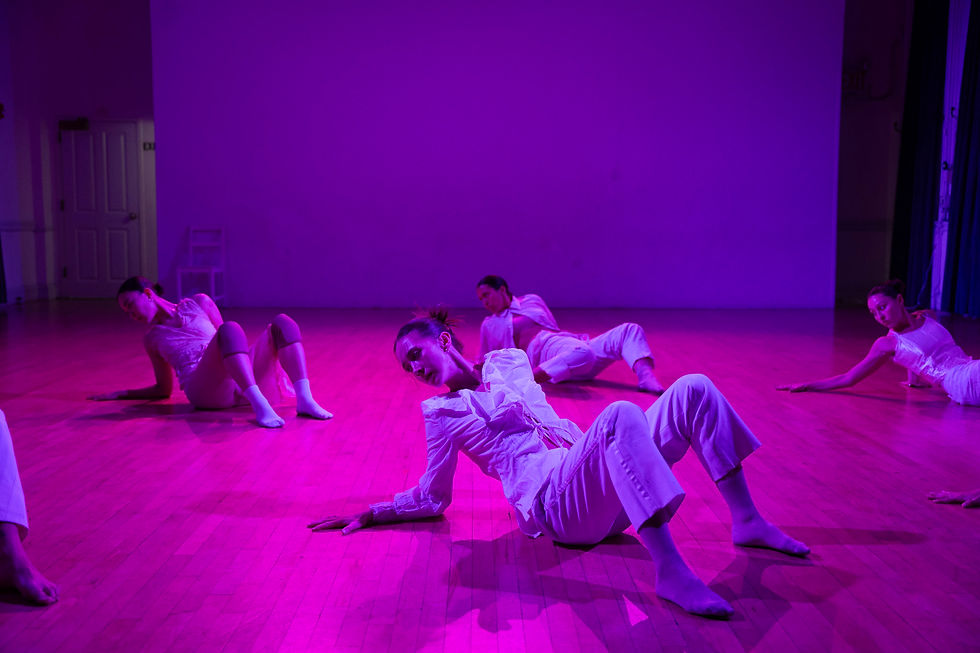
In a pre-performance address, Pizzi instructs the audience to pay attention to a specific moment: a dancer runs to the table and lies upon it, only to be carried center stage by the rest of the cast. We learn after the show that this transition marks where Pizzi and Takeshima—who collaborate regularly as Saraika Dance Collective—take over as creators. This moment arrives almost at the exact midpoint of the evening, and the resulting change in tone feels seamless and suitable rather than jarring.
The performers calmly reorganize the table and chairs, their movements reminiscent of the placid anticipation felt at the opening. While Pizzi and Takeshima maintain the cinematic atmosphere through simultaneous, varied scenes, their choreography employs more sinuous flow and floorwork. They also utilize counterpoint in distinct ways: a soloist (wearing only one shoe, as if interrupted mid-dress) executes full-bodied, traveling phrases while five others lie motionless upstage. Nearby, another dancer lines up dominoes along the right side, clearly depicting impatience, boredom, and the various techniques of distraction.
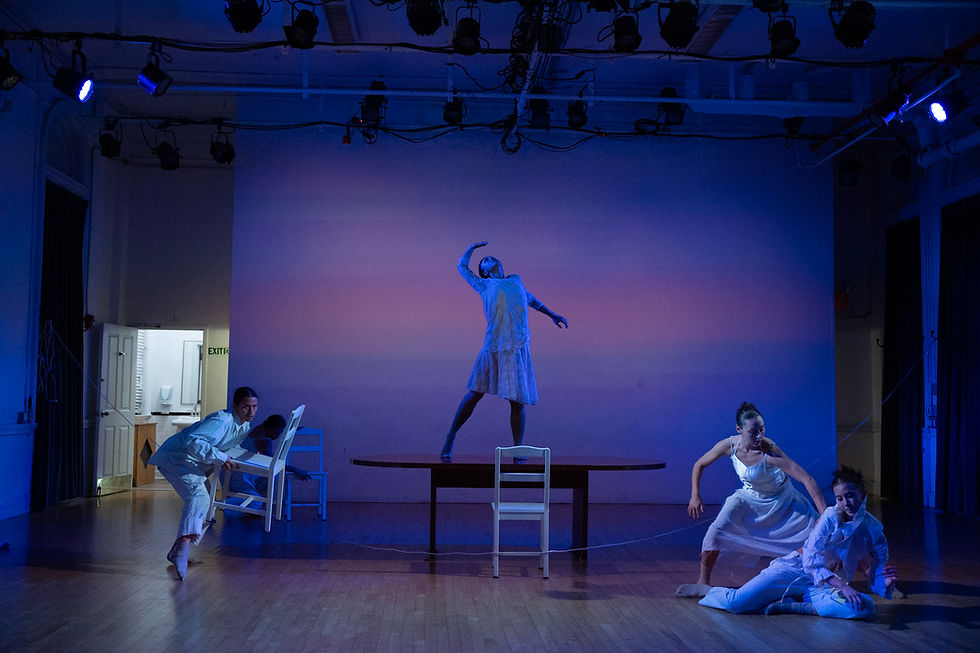
Pizzi and Takeshima’s section eschews sweeping group movement for smaller vignettes—solos or duets offset by trios performing contrasting phrases. A sequence where the performers switch chairs—walking, sitting, and swiping their legs over the chair backs—is especially pleasing; it culminates in prismatic duets where the dancers use the furniture, the floor, and one another to create an array of shifting, symbiotic shapes. In the end, the dancers unite in a series of supported lifts that appear and melt away, leaving one dancer lying on the floor. Suddenly, a phone rings; the dancers snap out of their languid reverie and bolt offstage. No one ever answers.

While an international collaboration of this scale could easily result in work that feels disjointed, the formula used by Tubini, Takeshima, and Pizzi works well. Just Keep Waiting is loosely narrative, its themes clearly communicated. While certain sections could be tightened for brevity, those moments do not detract from the piece’s overall aim. Their choreographic styles are different enough to be interesting and similar enough to be cohesive. Following the NYC premiere, the trio will bring the work to Italy, where it will be set on a new cast. The possibilities are intriguing, and I look forward to more partnerships of this kind. For that, I am willing to keep waiting.



Comments